Minimalist Focus Environment
Strip away visual noise and create space for deep concentration with minimalist themes designed for pure, uncluttered focus.
Complete Guide to Minimalist Focus Environments
The Psychology of Visual Simplicity
The human visual system evolved to scan environments for threats and opportunities. In cluttered spaces, this system works overtime processing every object in view—consuming mental resources even without conscious awareness. Research at Princeton University found that visual clutter reduces working memory performance and increases stress hormones. Minimalist environments calm this vigilant scanning, freeing cognitive resources for intentional focus. The psychological experience is spaciousness—room for thoughts to develop without competition. Understanding this mechanism reveals why minimalism works: it is not aesthetic preference but cognitive optimization.
Minimalism vs. Bare Emptiness
Effective minimalism is not sterile emptiness but curated simplicity. The goal is removing what distracts while retaining what supports. This distinction matters: completely bare environments can feel cold or institutional, actually reducing comfort and focus. The best minimalist setups include carefully chosen elements—perhaps a single plant, a beautiful but simple theme, or one meaningful object. These elements provide visual interest without visual noise. The principle is every element must earn its place by supporting focus or well-being. Anything that fails this test goes.
Digital Minimalism Principles
Digital environments often require more aggressive minimalism than physical spaces because digital clutter accumulates invisibly. Key principles: maintain single-purpose windows—one application, one task. Close browsers during non-research work. Use full-screen modes to eliminate peripheral distractions. Disable visual notifications during focus sessions. Choose operating system and application themes with minimal chrome. Each visible element—each icon, toolbar button, or status indicator—consumes some attention. Ruthlessly eliminate the unnecessary while ensuring the necessary remains accessible.
When Minimalism Serves Different Work Types
Minimalism supports various work types differently. For analytical work—coding, data analysis, detailed writing—extreme minimalism allows complete immersion in complex information. For creative work, slightly less austere minimalism provides visual comfort without overstimulation. For strategic thinking, minimal environments create space for big-picture cognition. The one work type where minimalism may require modification is brainstorming, where some visual stimulation can spark associations. Even then, controlled complexity beats chaos. Match your minimalism level to your task requirements.
Building Minimalist Habits
Minimalism is a practice, not a state. Clutter naturally accumulates; minimalism requires ongoing maintenance. Build habits supporting minimalist environments: clear digital clutter before ending each workday, maintain a clean desktop policy, review browser tabs weekly. Create friction for accumulation—resist saving files to desktop, close tabs immediately after use. These habits are small but compound significantly. The few minutes invested in maintenance prevent the hours lost to clutter-induced distraction accumulation.
Featured Themes
Each theme is carefully crafted to create the perfect atmosphere for your focus sessions.

Pure White
Clean & Bright
Dark Mode
Focused & Modern
Soft Gray
Neutral & Calm
Warm Paper
Gentle & Inviting
More Than Just Backgrounds
Minimalism in focus environments is not about deprivation—it is about removing everything that does not serve your concentration. Every visual element in your workspace either supports focus or detracts from it. Cluttered, busy environments constantly pull at your attention, even when you are not consciously noticing them. Research in environmental psychology confirms that visual complexity increases cognitive load and reduces working memory capacity. A minimalist focus environment provides only what you need: essential tools, calming aesthetics, and breathing room for your mind. The philosophy extends back to design movements emphasizing "form follows function" and forward to modern digital wellness approaches recognizing that attention is finite and precious. Bento's minimalist themes embody this philosophy with clean designs that let your attention rest where it belongs—on your work. The deliberate reduction creates space not just visually but psychologically, allowing deeper engagement with the task at hand.
Reduced Cognitive Load
Fewer visual elements mean less for your brain to process, freeing cognitive resources for the task at hand. Your visual system continuously monitors everything in view, consuming mental energy even without conscious attention. Minimalist environments reduce this background processing dramatically. Studies show that participants in uncluttered rooms score higher on attention and memory tests, suggesting that the cognitive savings from visual simplicity directly enhance mental performance.
Faster Focus Entry
Clean environments do not compete for attention, allowing you to enter flow states more quickly. The transition from scattered to focused attention happens faster when there are no environmental distractions to overcome. Minimalist setups reduce the activation energy needed to begin concentrated work. This matters especially when you have limited time windows for deep work—faster focus entry means more productive time per session.
Less Decision Fatigue
Minimalist setups reduce the constant micro-decisions about what to look at or interact with. Every item in view presents a potential choice: should I engage with this? Decision fatigue accumulates throughout the day, depleting the same mental resources needed for important work decisions. By eliminating unnecessary choices, minimalist environments preserve decision-making capacity for tasks that matter.
Calm Clarity
Visual simplicity creates mental spaciousness. Your thoughts have room to develop without crowding. Complex ideas need cognitive space to unfold—minimalist environments provide that space. The psychological experience of a clean environment feels expansive and clear, mirroring the mental state most conducive to quality thinking. This calm clarity supports both analytical precision and creative insight.
How It Works
Transform your focus sessions in three simple steps.
Clear the Excess
Start by removing visual clutter from your workspace—both physical and digital. Create blank space around your work area. Be ruthless: if it does not serve your current focus session, remove it from view.
Choose Minimal Themes
Select one of Bento's minimalist themes. These provide beauty and atmosphere with carefully curated simplicity. The themes offer visual interest without visual noise—the sweet spot for sustained focus.
Maintain the Space
Regularly clear clutter before it accumulates. Make minimalism a practice, not a one-time setup. Build brief clearing rituals into your workflow—a minute of tidying before each focus session pays dividends in concentration.
Get the Most from Your Themes
Expert tips to maximize your focus environment.
Start with Digital
Close unnecessary tabs and applications. A clean digital environment is often more impactful than physical decluttering because digital clutter occupies both visual and mental space—each open tab represents an incomplete loop your brain tracks.
One Tool, One Purpose
Keep only the tools you are actively using visible. Everything else should be closed or hidden until needed. This single-tasking approach prevents the attention fragmentation that multiple visible options create.
Embrace Empty Space
Resist the urge to fill blank space. Emptiness is a feature, not a problem to solve. The discomfort some feel with empty space often reflects the restlessness that minimalism helps address—learn to appreciate spaciousness.
Use Focus Box Mode
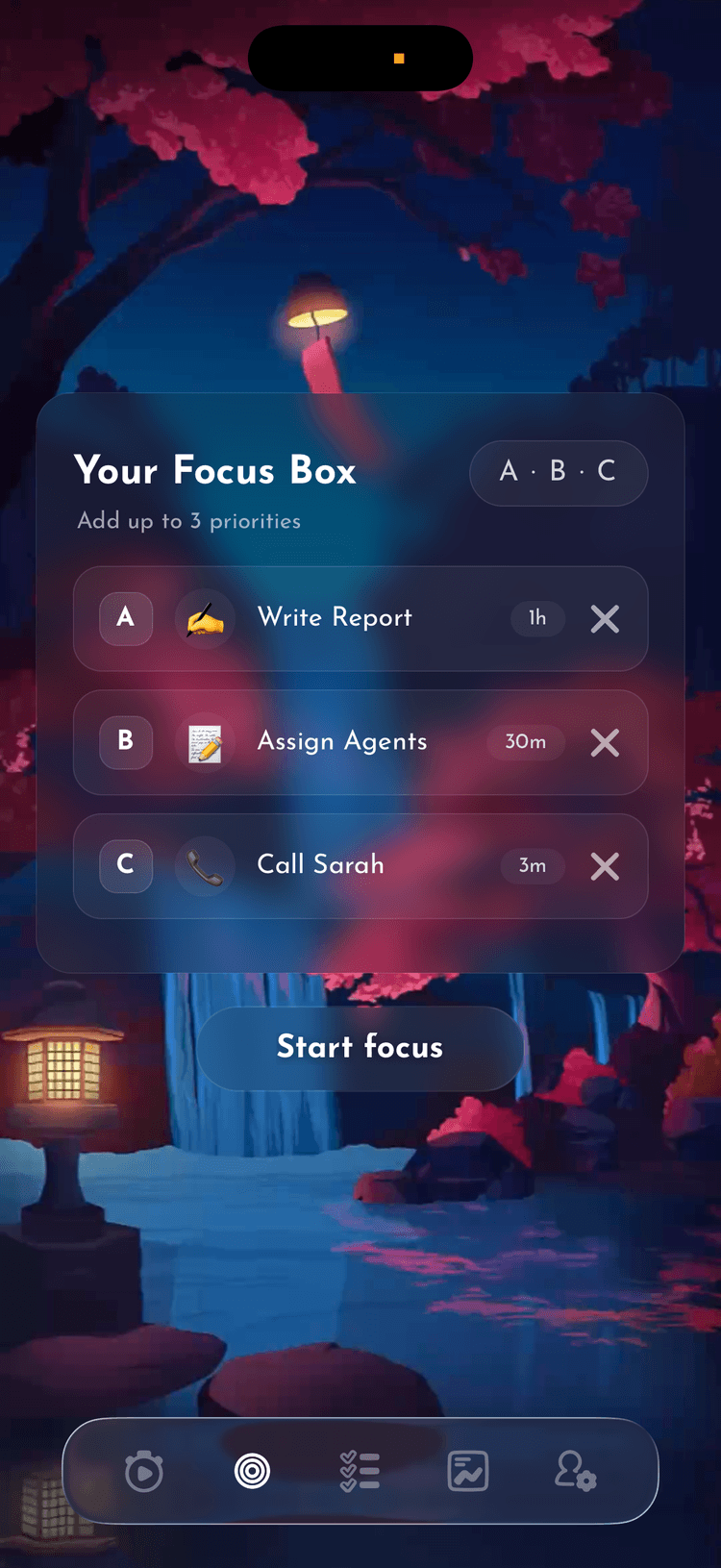
Bento's Focus Box removes everything except essentials, creating ultimate minimalism during focus sessions. This mode eliminates even the minimal interface elements, leaving only your task and timer.
Neutral Color Palette
Choose themes with muted, neutral colors. Bold colors can be stimulating; soft tones support sustained focus. The visual calm of neutral palettes reduces arousal levels, supporting the relaxed alertness optimal for concentration.
Regular Digital Decluttering
Schedule weekly reviews to close stale browser tabs, archive old files from your desktop, and clear notification queues. Digital clutter accumulates invisibly but impacts focus significantly. Maintenance prevents overwhelming cleanup sessions.
Mistakes to Avoid
Learn from others' experiences and sidestep these common errors.
Creating a minimalist digital environment while ignoring physical clutter
Apply minimalism consistently to both domains. A cluttered desk surrounding a minimal screen creates cognitive dissonance. Spend five minutes clearing your physical workspace before activating your minimalist digital theme.
Pursuing extreme minimalism that removes necessary tools
Minimalism means removing the unnecessary, not the necessary. If you frequently need certain references or tools, keep them accessible. The test is whether an element serves focus—if it does, it belongs even in minimal setups.
One-time decluttering without maintenance habits
Clutter accumulates continuously; minimalism requires continuous practice. Build brief clearing rituals into daily routines—a minute of tidying before and after focus sessions prevents gradual re-cluttering.
Using minimalism as procrastination through endless optimization
Good enough minimalism now beats perfect minimalism never. Create a sufficiently minimal environment, then focus on work. Refinement can happen gradually. Do not let environment optimization become avoidance of actual tasks.
Applying identical minimalism to all work types
Different tasks benefit from different minimalism levels. Experiment to find optimal simplicity for various work types. Some tasks thrive in extreme minimalism; others need slightly more environmental richness. Be flexible rather than dogmatic.
Real-World Examples
See how others apply these principles in practice.
Software Engineer Deep Code Sessions
A software engineer uses Bento's most minimal theme—a simple gradient background with subtle color shifts—during intensive coding sessions. The IDE occupies nearly the full screen with the Bento timer visible in a small corner. Browser is closed entirely; documentation is accessed only when specifically needed, then immediately closed. This extreme minimalism allows complete immersion in codebases. Bugs that previously took hours to find emerge in minutes when attention is fully concentrated. The environment has become associated with peak programming performance.
Executive Morning Strategy Blocks
A CEO reserves the first ninety minutes of each day for strategic thinking in a minimalist environment. The digital setup includes only a simple note-taking application and a clean gray Bento theme. Phone is in another room; email is inaccessible. This minimal context allows big-picture thinking that constant interruption fragments. Major strategic insights have consistently emerged during these protected minimalist sessions, making them the most valuable time of the workday.
Writer Daily Writing Practice
A novelist uses minimalist themes during daily writing sessions. The setup includes only a full-screen distraction-free writing application with Bento's subtle timer visible. The white theme provides clean backdrop without any visual interest that might divert attention from words. This minimalism supports the sustained attention long-form writing requires. Daily word counts have increased substantially since adopting this environment, and the writing itself feels more focused and clear.
Student Exam Preparation
A medical student uses minimalist themes during intensive exam preparation. The clean environment supports the dense concentration required for memorizing complex information. All study materials are digital to avoid physical clutter; only the current study resource is open at any time. The minimalist visual environment reduces cognitive load, leaving maximum resources for absorbing difficult material. This approach has improved both study endurance and information retention.
Common Questions
Everything you need to know about Bento themes.
Is minimalism boring? Will I lose motivation?
Effective minimalism is not sterile—it is intentional. Bento's minimalist themes retain beauty and subtle visual interest while removing clutter. Most people find they focus better without constant visual stimulation, and the satisfaction of deep work provides its own motivation. If minimalism feels oppressive, you may be pursuing excessive emptiness rather than curated simplicity. The right level feels spacious and calm, not bare and cold.
How minimal should my setup be?
Start by removing obviously unnecessary elements, then notice what you actually use during focus sessions. Keep those things accessible and beautiful; remove everything else. The right level of minimalism feels spacious but not empty. You should feel supported rather than deprived. If you frequently need something you have removed, restore it—minimalism serves focus, not ideology.
Can minimalism work for creative work?
Many creatives find minimalism enhances creativity by removing distractions and creating mental space for ideas to emerge. The constraint of simplicity can actually stimulate creative thinking. Some prefer slightly richer environments for brainstorming, then switch to minimal for execution. Experiment to find your optimal balance—creativity is personal, and different phases of creative work may need different environmental support.
What is the difference between minimalist and zen themes?
There is significant overlap, as zen aesthetics heavily influenced minimalism. Generally, zen themes include natural elements (stones, water, plants) while pure minimalist themes may feature more abstract or geometric simplicity. Both support focus through visual calm. Choose based on whether you respond better to natural imagery or pure abstraction—the psychological effect is similar.
How do I maintain minimalism when work requires many tools?
Complex work does not preclude minimalism—it requires smarter minimalism. Use workspaces or virtual desktops to separate tool sets. Keep only currently active tools visible. Use application launchers to access tools quickly without keeping them always visible. The principle remains: visible only when actively needed, hidden otherwise.
Will others think my minimal workspace is strange?
Minimalism has become increasingly mainstream as attention challenges grow. Many find minimal workspaces inspiring rather than strange. If colleagues question your setup, the performance benefits provide compelling justification. Your visible focus and productivity will demonstrate the value better than explanation.
How long does it take to see benefits from minimalist environments?
Many people notice immediate calm upon entering a clean environment. Deeper benefits—faster focus entry, longer sustained attention, reduced end-of-day fatigue—develop over weeks of consistent use. Like any practice, minimalism improves with time as you refine your setup and your brain learns to associate simplicity with focused work.
Experience Beautiful Focus
Download Bento and discover themes that make focus sessions something to look forward to.

Scan to download
Available on the App Store